Descrizione
Il “vecchio sentiero dei mulini”

|
| tratto in rosso: percorso mulini alto Linòr |

|
| tratto in rosso: percorso mulini basso Linòr |
Lungo la vecchia strada comunale che collegava Cavareno ad Amblar, prima della costruzione del ponte Linòr, troviamo la località “ai Molini” composta da un piccolo gruppo di case. Queste costruzioni, situate sulla riva destra del percorso del rio Linòr, ed ora abitazioni, racchiudono fra le loro mura la storia delle attività di un tempo di molini e segherie. Lungo tutto il percorso del rio Linòr- in un tratto di circa 2,5 Km, dalla zona a nord del paese di Amblar alla sua confluenza nel rio Moscabio a ovest del paese di Don- operavano numerose aziende artigiane che sfruttavano l’azione di ruote idrauliche, alimentate dalle acque del torrente, per la molitura dei cereali, la segagione del legname e non solo. Il vecchio sentiero, nei secoli è stato modificato ed tratti non è visibile perché rimboschito; attualmente si divide in due percorsi che partono rispettiva-mente dalle due frazioni di Amblar e Don.
La storia

|
| estratto mappa di una cartografia del 1859: nell’allora Comune di Don lungo il rio Linòr (nella mappa erroneamente segnato come Vallavena) c’erano 6 mulini(evidenziati con i numeri in rosso) |
La nascita dei mulini e delle segherie risale ancora al 1500 ed addirittura alcuni al 1300. Per secoli rimasero al servizio dei residenti dei paesi di Amblar e Don, passando fra diversi proprietari che provenivano anche da altre zone del Trentino. I loro servizi furono sempre più utilizzati, non solo dai residenti, ma anche dai residenti dei paesi vicini di Ruffrè, Salter, Ronzone…ecc che portavano a macinare il grano, mais, orzo, o il legname per tagliare assi e travature per costruzione…ecc. Il mugnaio e il segantino era sempre più ricercato e diversi residenti ne fecero la loro attività principale. I mulini vissero il loro massimo splendore dalla metà del 18° secolo alla metà del 19° secolo. Si menziona che nel 1879 ad Amblar i mulini potevano macinare da 250 a 600 chilogrammi di farina al giorno: un record per quei tempi.
Negli anni ’60, con l’abbandono della campagna, non si coltivavano più cereali; le segherie ad acqua, furono sostituite da quelle elettriche. Questo ha determinato inesorabilmente la fine di queste attività ed i relativi fabbricati vennero trasformati in abitazioni private e in certi casi abbandonati come ruderi.
I “mulini” di Amblar e Don

|
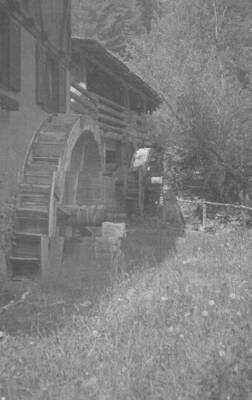
| mulino a due ruote |
Alcuni mulini svolgevano anche l’attività di segheria e vi era anche una fucina. I fabbricati erano situati, l'uno dopo l'altro, lungo la sponda destra del rio Linòr, dato che per le lavorazioni sfruttavano l'energia prodotta dall’acqua dei torrenti. Siccome i mulini si trovano un po’ distanti dal letto del Linòr, si costruiva un “canale di mulino”, a monte del mulino, che uscendo dal corso del rio portava l’acqua necessaria per azionare le ruote, per poi rientrare più a valle. Generalmente i mulini erano dotati di due ruote di dimensioni diverse, la più grande per macinare i cereali, la più piccola per uso segheria. Il flusso dell’acqua veniva spostato in direzione della ruota utilizzata.
Nel 1879 erano cinque nel Comune di Amblar e sei nel Comune di Don e venivano identificati con il nome del loro proprietario contemporaneo.
Percorso dei “mulini” alto Linòr (mulini di Amblar)
Percorso dei “mulini” basso Linòr (mulini di Don)
 Description
Old watermill trail
|
|
| red line: alto Linòr watermill trail |
|
|
| red line: basso Linòr watermill trail |
Along the old town road that used to go from Cavareno to Amblar before Linòr bridge was built, we come to a small group of houses known as “ai Molini". The walls of these buildings, on the right bank of the Rio Linòr, now homes, are the custodians of a time when gristmills and sawmills were operating. All along the Rio Linòr, for a stretch of about 2.5 km, from the area to the north of Amblar and its confluence into Rio Moscabio to the west of Don, many small family businesses operated, using waterwheels powered by the river to grind cereals, saw lumber and more. The old path has been altered and some stretches are hard to spot as they have grown over. Today it is split into two routes, one starting from the village of Amblar, the other from Don.
History
The birth of the gristmills and sawmills dates right back to the 1500s, with some even as old as the fourteenth century. For centuries they were used by the residents of Amblar and Don and their different owners even came from other areas in Trentino. Their services were used more and more frequently, not only by locals but also by people from the nearby villages of Ruffrè, Salter, Ronzone and others, who would bring wheat, corn, and barley for grinding or timber to be cut into planks and beams for building. There was a growing demand for millers and sawyers and many locals made it their main job. The watermills enjoyed their golden age from the mid-eighteenth to the mid-nineteenth century, and in 1879 it was noted that the gristmills in Amblar could grind from 250 to 600 kilograms of flour in a day: a record for that time.
In the sixties, when people started to abandon the countryside and cereals were no longer cultivated, the water-powered sawmills were replaced by electric ones. This led inexorably to the end of this activity and the relative buildings were turned into private homes and in certain cases abandoned and became ruins.
The watermills in Amblar and Don
Some of the watermills were also used as sawmills and even had a forge. The buildings stood, one after another, along the right bank of the Rio Linòr, because they were powered by the energy produced by the river water. As the mills were a short distance from the riverbed, a mill race would be built upstream of the building to bring the water needed to power the wheels from the river itself and then this was channelled back in further downstream. The watermills generally had two wheels of different sizes, the biggest for grinding grain and the smaller one for the sawmill. The water flow was moved to power whichever wheel was being used.
In 1879 there were five in Amblar and six in Don and they were called by the name of their owner at the time.
Alto Linòr watermill route (Amblar watermills)
Basso Linòr watermill route (Don watermills)
 Beschreibung
Der alte Mühlenweg
|
|
| Rote Linie: Oberer Linòr-Mühlenweg |
|
|
| Rote Linie: Unterer Linòr-Mühlenweg |
Der Weiler „ai Molini“ liegt an der alten Gemeindestraße, die vor dem Bau der Brücke über den Linòr Cavareno mit Amblar verband. Die Gebäude am rechten Ufer des Linòr, die heute Wohnzwecken dienen, verbergen hinter ihren Mauern die Geschichte der Mühlen und Sägewerke vergangener Zeiten. Entlang des Linòr, auf einer Strecke von ca. 2,5 km, vom Gebiet nördlich des Dorfes Amblar bis zum Zusammenfluss mit dem Moscabio westlich des Dorfes Don, siedelten sich einst zahlreiche Handwerksbetriebe an, die die Wasserkraft des Baches zum Mahlen von Getreide, zum Sägen von Holz usw. nutzten. Der alte Weg hat sich im Laufe der Jahrhunderte verändert und ist zum Teil nicht mehr sichtbar, da er zugewachsen ist. Heute gibt es zwei Wege, die von den beiden Dörfern Amblar und Don ausgehen.
Die Geschichte
Die Mühlen und Sägewerke gehen auf das Jahr 1500 zurück, einige sogar auf das Jahr 1300. Sie dienten jahrhundertelang den Bewohnern der Dörfer Amblar und Don und wechselten ihre Besitzer, die auch aus anderen Teilen des Trentino stammten. Ihre Dienste wurden immer mehr nicht nur von den Einwohnern, sondern auch von den Bewohnern der Nachbardörfer Ruffrè, Salter und Ronzone in Anspruch genommen. Sie kamen in die Mühle, um Getreide, Mais und Gerste zu mahlen oder um Bretter und Balken für Bauholz zu schneiden. Müller und Säger wurden immer gefragter, und mehrere Einwohner machten dies zu ihrem Hauptberuf. Ihre Blütezeit erlebten die Mühlen von der Mitte des 18. bis zur Mitte des 19. Jahrhunderts. Im Jahr 1879 sollen die Mühlen von Amblar 250 bis 600 Kilogramm Mehl pro Tag gemahlen haben: ein Rekord für die damalige Zeit.
In den 1960er Jahren wurde der Getreideanbau aufgrund der Abwanderung eingestellt. Wasserbetriebene Sägewerke wurden durch elektrische ersetzt. Dies führte unweigerlich zum Ende dieser Aktivitäten. Die Gebäude wurden zu Wohnzwecken umgebaut und teilweise dem Verfall preisgegeben.
Die Mühlen von Amblar und Don
Einige Mühlen dienten als Sägewerke, andere als Schmieden. Sie befanden sich alle am rechten Ufer des Baches Linòr, da sie die Energie des Wassers für ihre Arbeit nutzten. Da die Mühlen etwas entfernt vom Bachbett des Linòr lagen, baute man einen „Mühlenkanal“, der aus dem Bachlauf kommend das für den Antrieb der Räder benötigte Wasser heranführte und weiter abwärts wieder zurückführte. In der Regel waren die Mühlen mit zwei unterschiedlich großen Rädern ausgestattet, von denen das größere zum Mahlen des Getreides und das kleinere zum Sägen verwendet wurde. Der Wasserfluss wurde in die Richtung des verwendeten Rades gesteuert.
Im Jahr 1879 gab es fünf Mühlen in der Gemeinde Amblar und sechs in der Gemeinde Don, die nach dem jeweiligen Besitzer benannt wurden.